

- Sequence Smarter / Nanopore WGS
Nanopore Long-Read Whole-Genome Sequencing
Oxford Nanopore long-read whole-genome sequencing for bacteria, fungi, mixed populations, and metagenomes. SeqCoast uses R10 chemistry, performs SUP basecalling, includes POD5 files, and offers volume-based pricing from dozens to thousands of samples.
SeqCoast provides high-throughput Oxford Nanopore whole-genome sequencing for microbial isolates, mixed populations, and metagenomes. We run PromethION flow cells with the latest chemistry to deliver long-read data for variant calling, assembly and annotation, and comparative genomics, at batch sizes from dozens of samples to tens of thousands.
Why use Nanopore long reads at SeqCoast?
Identify important indels, repetitive regions, and structural variations that short reads alone can't resolve.
Reads up to 100 kbp and occasionally much longer, limited mainly by the length of the DNA you send.
We run projects from dozens of samples to tens of thousands.
We use Nanopore’s most recent R10 sequencing chemistry for high read accuracy.
Applications
Example microbial sequencing targets:
-
Microbial isolates:
- Bacteria
- Fungi (yeast, filamentous)
- Protozoans
- Single-cell eukaryotes (e.g. algae, amoeba)
- Whole populations (e.g. experimental evolution, intrastrain diversity)
- Metagenomes (e.g. microbiome, soil, contrived communities, wastewater)
Example applications for long-read sequencing:
-
Assembly and annotation
- Because long reads can span difficult-to-assemble regions, they can generate robust, single-contig genome assemblies.
- For even better assembly quality, we recommend leveraging both the quality of short reads and the read lengths of long reads using our hybrid sequencing service.
- Reference-based variant calling for clones or populations
-
Metagenomic profiling
- Longer read lengths support more robust metagenome assemblies than short reads alone.
- Long-read metagenomic analysis, metagenome assembly, and MAGs are available as a custom analysis.
-
Identification of base modifications (e.g. methylation)
- While basecalling of modified bases is not included in our standard services, we provide Pod5 files that allow you to run the analysis yourself. Alternatively, we can offer this as a custom service.
SeqCoast features and benefits
Our expertise and high-throughput capabilities make us the ideal partner for custom projects of any size or complexity, whether you have dozens or thousands of samples.
Flexibility at scale
- High-throughput sequencing, with capacity to process tens of thousands of samples.
- Data volumes ranging from 300 Mbp to 1.5 Gbp+ per sample.
SeqCoast is an Oxford Nanopore Service Certified laboratory!
- This certification underscores our expertise and commitment to delivering the highest quality services using the latest advancements in long-read sequencing technology.
Gold-standard library preparation and sequencing
- Nanopore library prep and sequencing reagents – no off-brands, homemade reagents, or compromised quality.
- Ligation-based library preparation to preserve the length of your DNA and bypass PCR-related errors. Not all providers use this method!
- Sequencing of native DNA strands, which allows for the identification of base modifications.
- High read accuracy using super-accurate (SUP) basecalling mode: Regularly achieves Q20+ (99%+ modal accuracy) for high-quality samples.
- We provide FastQ files and POD5 raw data files, so that you can perform additional analyses later as Nanopore data algorithms become more advanced.
Multi-point QC
- All samples checked upon arrival to ensure they have arrived intact and conform to biosafety standards.
- DNA fragment length distributions and library concentrations are measured to ensure appropriate library pool balancing and optimize data output for each sample.
- Sequencing run quality metrics checked by a qualified expert.
- Custom QC services available upon request for large orders.
Need custom sequencing?
Most projects are covered by our standard analysis pipelines above. If your project requires custom analysis, tell us about your project goals and needs!
How to prep samples for submission
Send raw samples
- Send raw samples for our robust DNA extraction workflow.
Or send purified DNA
- Send >50ng/ul of DNA in a volume of >50ul eluted in nuclease-free water or dilute TE.
- We accept samples that have lower concentrations/volumes, but they may have a lower chance of success.
Quantification and elution
- We strongly recommend quantifying by Qubit or other fluorometric method, as other methods (such as Nanodrop or Tapestation) are often wildly inaccurate.
- We recommend eluting samples in nuclease-free water or diluted TE, but we do accept other elution buffers.
- Excessive EDTA and extraction contaminants (salts, phenol, polysaccharides, etc.) can cause sample failure.
48+ samples
- We offer our COMPASS system for CoOrdinated Management and Processing for Accelerated Sequencing Services.
- COMPASS allows for the fastest processing and the lowest price!
- You will receive a custom shipping container with validated plasticware, stabilization buffer, & prepaid shipping label at no additional charge.
24-48 samples
- Must be sent in a 96-well plate or individually-capped 8-tube strips.
- 96-well plates should be fully-skirted and sealed well with a foil seal (plastic seals are very prone to leaking during shipping).
<24 samples
- Individually-capped 8-tube strips (preferred) or 1.5 mL tubes.
96-well plates
- Label with Order Number and (if necessary) Plate Number.
Tubes
- Label caps with SeqCoast Sample ID (assigned in your Sample Manifest).
- Labeling tubes with your own sample names instead of the SeqCoast Sample IDs can cause delays!
Please send
All samples must be securely packaged in a clean, organized fashion using secondary containment. Leaking samples will be immediately disposed of, as required by our biosafety measures.
Please do not send
Bags of tubes, individual tubes wrapped in parafilm, large-format tubes (e.g. 50ml conicals), non-sterile/soft-sided containers (e.g. plastic bags), unsealed cell culture 96- well plates. We’ve seen it all! Please double-check your shipments to ensure your samples make it to us safe and sound.
Data delivery, security, and access
We make it easy to access your data!
- Most Nanopore orders are completed within 14 business days of sample receipt.
- Data delivery options include SFTP Download, AWS transfer, Box.com, and alternatives on request.
- Data are stored on AWS cloud infrastructure in the United States, providing scalable storage, high availability, and industry-recognized security controls.
- Read more about our data infrastructure here.
Pricing — the more you order, the lower the price!
Fewer than 24 samples per batch
Use our self-serve option to get a quote or order instantly for these small projects.
Looking to run a pilot for your large project? Get in touch with our team for custom pricing.
Get a custom quote to see our amazing project-based pricing.
Large sample quantities:
- Access our COMPASS system for fastest turnaround and lowest price.
- Ask us about our pilot batch program!
- Get complimentary analysis reports.
Long-term projects get all of the above, plus:
- Consistent processing across large studies
- Long-term contract opportunities
- Scientist-to-scientist support
- Advanced Genomic Insights incentive program
How much sequencing data do I need for Nanopore sequencing?
If you are unsure about the data volume per sample you need, we recommend that you do one of the following:
- Perform a literature search for similar sample types and analyses.
- Send pilot samples aiming for more data than you think you need, then use down-sampling methods to determine the optimal data volume for your full experiment.
While we do not provide specific recommendations for every project, please see the following table for illustrative examples of data volume tiers that our customers have used:
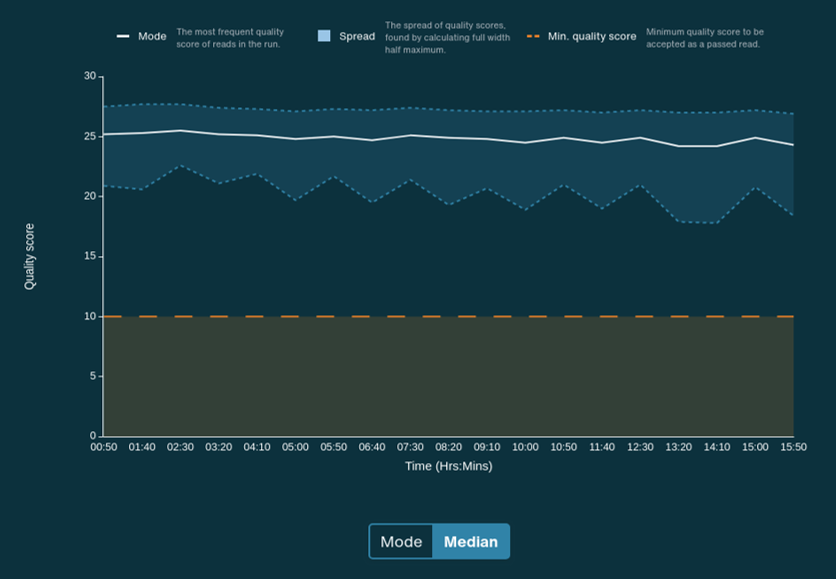
QScores
Frequently Asked Questions
How should I extract my DNA?
Let us do the hard work for you! We offer DNA extraction using bead beating lysis.
Our DNA extraction service can isolate high-molecular-weight DNA from a wide range of sample types and can make all the difference for getting high-quality sequencing results!
If you want to tackle the extraction yourself, many column-based extraction kits provide good results, as do other methods if care is taken to remove contaminants. Our library prep methods work best with buffers containing less than 1mM EDTA.
Remember that you want long pieces of DNA to make the most of your long-read sequencing.
While harsh methods like bead beating are often necessary for tough-to-lyse microbes, we recommend that you take any reasonable steps to reduce the shearing of your DNA during this process.
Can I send a lower concentration or volume than your recommendations?
Yes, we are often successful with lower-concentration samples and are happy to process any samples that you send!
Please note that samples that do not meet our recommendations have a lower chance of success.
How long should my DNA be for Nanopore sequencing?
Nanopore sequencing can handle any length of DNA, but most applications benefit from providing DNA that is as long as possible.
Specific requirements will depend on your particular sample type and project goals, but most customers aim to send DNA with average fragment lengths of ~10,000 bp or longer.
How much sequencing data should I order?
See the “How Much Sequencing Data Do I Need for Nanopore Sequencing?” section above.
Does the library preparation include PCR amplification or shearing?
No, our Nanopore library preparation does not include amplification or shearing. It is ligation-based, so your original DNA strands are what gets sequenced.
Do you have requirements for A260/230 and A260/280 absorbance ratios?
Our library preparation workflows are generally quite robust and can tolerate moderate deviations from ideal absorbance ratios.
We do not have requirements surrounding absorbance ratios and will not provide recommendations on whether your ratios are sufficient.
However, please be aware that lower-quality samples have lower chances of success and may require that you perform a cleanup prior to sending them for sequencing.